

Beyond the Algorithm: What AI Still Can’t Teach Us

From left, Dr Haoran Cheung Ho-yin, Dr David Chan Tse-tin, and Dr Davy Ng Tsz-kit.
In the past few years, AI has brought sweeping changes to almost every aspect of society, and education is no exception. To understand how educators should respond to the AI wave, FLASS FORWARD spoke with two experts in STEM education and educational technology from the Department of Mathematics and Information Technology (MIT): Dr Davy Ng Tsz‑kit and Dr Haoran Cheung Ho‑yin. FLASS FORWARD was also glad to have Dr David Chan Tse-tin, from the same department, moderate the discussion.
The interview explored how AI is affecting teaching and learning, as well as the drawbacks of misusing it. It also addressed a fundamental question: what unique and irreplaceable value humans retain in an age where AI can perform complex tasks such as writing, analysing, designing, translating, and even offering emotional support. They also reflected on the future of university education, and on what should still be taught when knowledge quickly becomes outdated and AI can provide instant answers.
Dr Chan is currently the Chair of the Departmental Research and Development Committee of MIT, Dr Cheung is the Programme Leader for the Bachelor of Science (Honours) in Artificial Intelligence and Educational Technology (BSc(AI&EdTech)) programme, and Dr Ng is Programme Coordinator of the Professional Development Programmes (ICT).
Dr Ng: My undergraduate studies were in computer science, when computational thinking and STEM education were prominent in academia. After graduating, I completed my Postgraduate Diploma in Education (PGDE), then began teaching Information and Communications Technology (ICT) in a secondary school. I also served as the school’s STEM coordinator for about two years. I later pursued a Master of Education (MEd) in Educational Psychology and eventually went on to complete a PhD in Education and Technology. This combination of classroom experience and postgraduate study helped me understand how to connect technology, educational psychology, and practical pedagogy.
During my master’s and doctoral studies, I discovered a genuine passion for research and academic writing. At that time, I had the chance to work on a few exciting education‑related projects, such as using 3D printing to help students visualise abstract mathematical concepts, and using AI to create simulations and applications for STEM education. I also developed a keen interest in finding ways to make learning both more effective and enjoyable. This desire to improve student outcomes through research made the move into higher education feel like a natural next step for me. I joined EdUHK in 2024.
Dr Cheung: My undergraduate degree and Master of Philosophy (MPhil) were in theoretical physics. Back then, I worked on both theoretical physics and computational physics, which involves writing computer programmes to simulate physical systems. My research also covered genetic algorithms, which were an important technique in evolutionary computation and AI. That was my first exposure to AI.
After graduation, I taught on associate degree programmes at a local university, where I ended up teaching mathematics, science, computers, and many other science‑related subjects offered in these programmes. After teaching for nine years, I realised that although I had strong subject knowledge, I did not know how to teach effectively. As a result, I pursued a Doctor of Education degree to learn educational theory. After graduation, I joined EdUHK in 2022.
While my academic training was rooted in theoretical physics and education, my work also involved computer science and AI. Over the past few years, the academic world has been deeply concerned about how to integrate AI into education in ways that genuinely benefit students. I don’t assume AI is automatically “good”. For me, the questions that matter are: how should AI be used wisely, and what unique value do students, teachers, and human beings still bring in the AI era? If AI is used wrongly, it can seriously harm education.

Dr Cheung says that when everyone uses AI tools in the same way, the results start to look the same everywhere, a sign of the superficial understanding behind this homogenisation.
Dr Cheung: To explain the harm, I want to highlight the difference between information and knowledge. In education today, many students use AI to generate answers. But when everyone uses similar tools in similar ways to produce similar answers, everyone starts to look the same. This is called homogenisation, and behind it usually lies a superficial understanding of the issues: you know that something exists, but you don’t really understand why it exists or how to change it.
When everyone's understanding is superficial, employers find it hard to tell candidates apart. You have no advantage over others. You cannot prove your value to an organisation. You cannot survive when AI can process and present information more effectively than you.
AI can provide a wealth of information, but information is not knowledge. Knowledge grows only when we apply information to solve real problems. That’s when higher-level thinking comes in: you judge the relevance and reliability of information, compare different pieces of it, and reason your way to a solution.
Modern neuroscience offers a useful way to understand this point. Through repeated practice and active problem-solving, the brain can strengthen and refine the neural connections involved in particular skills and patterns of thinking. In other words, students develop deeper understanding not simply by receiving information, but by actively using it, questioning it, and applying it to real problems. The danger is that if students rely too much on AI to replace their own thinking, they lose opportunities to construct their own knowledge. That’s one of the biggest risks in this AI age.
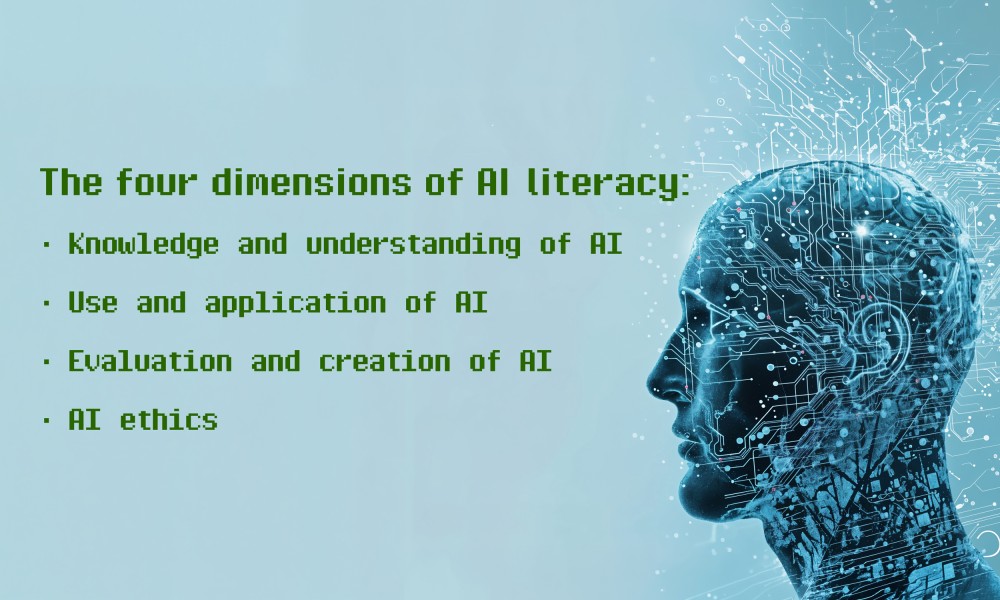
Dr Ng: What Haoran has just discussed is really about AI literacy. Although the meaning of AI literacy keeps evolving and is conceptualised from different perspectives, it often includes four dimensions: (1) knowledge and understanding of AI, (2) use and application of AI, (3) evaluation and creation of AI, and (4) AI ethics, all of which based on Bloom’s taxonomy. These dimensions help people understand how AI works, how to use it effectively, how to judge its outputs, and how to apply it responsibly and meaningfully in different contexts.
The first dimension concerns AI knowledge and skills. Every day, new AI tools and concepts emerge in the market, such as agentic AI, digital humans, and embodied AI, each bringing its own possibilities and challenges. Different people need different kinds of contextual knowledge. For example, teachers designing lesson plans need to know how to use AI to support meaningful learning. Good lesson design should encourage interaction among students, instead of adopting “AI-generated materials directly”. This necessitates students to scaffold, regulate and support their own learning process with AI. It is also essential for them to understand the functions and limitations of different AI tools. Different tools can raise different issues, including privacy and security risks. For example, avatars may involve sensitive biometric data.
The second dimension focuses on the application of AI across different contexts. When students write explanatory or argumentative texts, or solve science and maths problems, they must use facts correctly and check whether the argument is valid. But if they are drafting a reply to a complaint, they need emotional resonance and empathy instead. This is what we mean when we say that how AI should be used depends on the context.
Dr Cheung: We can look to history for answers. When the steam locomotive emerged in the early 19th century, many horse carriage drivers feared they would lose their jobs. While horse carriages did become obsolete, new opportunities arose in manufacturing and maintaining locomotives. This example shows that technological change doesn’t just destroy jobs. It also creates new ones.
I learnt to use an abacus in primary school. Then pocket calculators came along. Now that online tools and AI can perform calculations much faster than any human, abacus is not the preferred choice anymore. And when AI can write computer programmes today, do we still need to stick to traditional coding (古法編程, literally “old‑method coding”, a cheeky term for doing things the traditional, unassisted way)?
I don’t mean that basic training in arithmetic or coding is no longer important. Students still need these foundational skills to understand concepts, develop discipline in thinking, and judge whether AI-generated answers make sense. The point is that such training should serve as a foundation for higher-order abilities, rather than becoming the ultimate goal of education.
AI can support human activity, but the uniquely human qualities of judgement, responsibility, relationships, and personal experience remain invaluable.
I think human value does not come from “beating machines” in calculation or coding. Indeed, AI’s power is developing so rapidly that we can never outperform it in all these areas. We should instead embrace what AI frees us from. When AI takes on tedious, repetitive tasks like calculation, we can focus on deeper thinking, reflection, and better judgements. Those are uniquely human capacities.
In aviation, autopilot systems have been used for many years, yet pilots remain essential, both for their skills and because legal responsibility generally remains with human operators or organisations rather than AI or machines. Genuine human relationships, such as those between teachers and students, cannot be replicated by AI either. Only human teachers can be respected by students, and have their authority recognised, within a meaningful human relationship. This is what AI cannot achieve.
I recently asked AI to design a travel plan for me. While AI could suggest routes and attractions, my own preferences for sightseeing spots and food mattered most in the end. And AI cannot replace the subjective experience of travelling itself. I think this example shows just how important human participation really is. AI can support human activity, but the uniquely human qualities of judgement, responsibility, relationships, and personal experience remain invaluable.

Both Dr Cheung, left, and Dr Ng believe that in the AI age, human relationships, creativity, empathy, and care matter more than ever.
Dr Ng: Haoran just spoke about how people’s understanding of the world develops, moving from information to knowledge and then to wisdom. In relation to this, I thought of a recent research project involving older adults and children who learnt how to co-write stories using AI.
After learning from the elderly residents’ stories, the students produced creative stories with fuller, more textured content.
In this project, we brought a group of secondary school students to older, established districts in Hong Kong such as Sai Wan Ho and Shek Kip Mei. There, elderly residents shared stories and cultural insights about the communities. These are the kinds of experiences that AI cannot create on its own. We found that the students were highly creative in their writing. However, because they lacked rich life experiences, their stories sometimes missed the “human touch”. After learning from the elderly residents’ stories and using AI as a writing aid, the students produced creative stories with fuller, more textured content. This echoes what Haoran has just said: humans play an important role in transforming information into knowledge and wisdom.
Going back to our earlier discussion on AI literacy, it really breaks down into two big parts. The first two dimensions are on the operational side, covering how to use AI effectively. The last two are about the critical and ethical side, covering how to use AI responsibly in teacher professional practice and in students’ learning.
EdUHK is an institution dedicated to training future teachers. We hold a professional expectation that our graduates possess the right subject knowledge as well as critical and original thinking skills. They should also know how to nurture creativity in the next generation. But our vision goes further. Future teachers need more than knowledge and skills: they need values and empathy too.
The abilities to empathise and care, the qualities that AI cannot replace, give teachers the “authority” to teach. I invited several undergraduate students to help in a recent research project. In this project, secondary learners were guided by our students to create personalised fitness plans for the elderly. We emphasised that secondary learners needed to be empathetic and caring so they could factor in the needs of the elderly when designing the plans. Through these projects, we teach more than knowledge; we teach people how to be human.

Dr Chan emphasises that AI cannot replace the love and care found in genuine human relationships.
Dr Ng: Most of our bachelor’s and master’s programmes, and Professional Development Programmes (PDP) run project-based learning courses. In these courses, students are often required to do group projects. Usually, groups use AI to ideate and make learning applications for their projects. What we encourage them to do next is to identify appropriate end users through their own networks, and then collect feedback from them to improve the applications. This approach reflects pedagogical theory that moves students’ learning from knowledge to praxis. I think our education should emphasise praxis even more. It trains people’s ability in project planning to address real-world problems, and in working with others: human skills that matter more than ever as AI takes over other tasks.
Dr Cheung: Before answering your question, I want to give an overview of how to design a course through the lens of constructive alignment. A well-designed course has three elements: intended learning outcomes, teaching methods, and assessment. The learning outcomes define what students should achieve. Teaching methods then help students reach these goals. This is where scaffolding comes in: a supportive structure that helps learners progress from foundational skills to higher-level capabilities. Finally, assessment checks whether students have achieved the intended outcomes: formative assessment supports learning during the course, while summative assessment evaluates end-of-course performance against the expected outcomes.
In the past, intended learning outcomes often focused on lower-level skills like remembering and understanding. But in the AI era, people can access information easily. So simply recalling facts is no longer the main goal of learning. When AI can give quick answers, universities should focus on cultivating students’ ability to judge, improve, and create solutions. These are the higher-order skills that Bloom’s taxonomy calls application, analysis, evaluation, and creation.
For instance, when AI gives several possible answers to a question, students need to check which is correct and choose the best one—that’s evaluation. When AI cannot fully solve a problem, we need to think up new approaches—that’s creation.

Dr Chan asks the two MIT scholars how educators should change the way they assess students in the AI era.
Dr Cheung: You are probably right that when students can use AI to generate answers, it is meaningless for a course to assess students only by their final answers. So rather than assessing only the final outcomes, we look at the learning process. In one of our master’s level courses, instead of asking students to submit a literature review (which AI can now generate easily), we ask them to conduct interviews to collect practical advice from teaching professionals and then write an analysis based on the interviews.
During the interview process, students have to think through the questions, respond, and analyse what the interviewees say. Students must pull out what actually matters, interpret what the interviewees really mean, and build their own arguments from it. This makes learning visible and encourages real critical engagement rather than copy-and-paste responses.
Dr Ng: We’ve discussed that many curriculum theories can be understood through three connected elements: intended learning outcomes, the learning process, and praxis. In this framework, praxis refers to the lived practice of teaching: how curriculum plays out in real contexts, not just how it is planned on paper.
In traditional teaching, students often stay within classroom boundaries. But praxis makes a shift: students should go beyond the classroom and test what they learn against real-world situations. This shift matters especially in secondary schools, where learning often happens mostly inside the classroom.
One way to support this shift is to use AI to expand learning beyond the classroom. For example, students can use digital human avatars to learn how to tell life stories. With teacher guidance, students can then discuss how avatar-based storytelling connects to real industries, such as the film and television sector. Teachers can also raise value questions during these discussions, for instance whether acting skills remain valuable when avatars can replace real actors in film production.
Students shouldn’t treat learning as just “retrieving” information from AI; instead, they can use AI for feedback that helps them reflect.
Another approach is to involve students in authentic community-based activities, such as interviewing elderly residents in older districts, as mentioned earlier. This helps students connect learning to real, lived experience. At the same time, AI can support self-regulated learning and reflection. Students shouldn’t treat learning as just “retrieving” information from AI; instead, they can use AI for feedback that helps them reflect on what they’re doing and what they’ve learnt.
Whether and how teachers use AI to teach and assess remains a complex issue. The goal is not to use AI for convenience, but to use it in ways that genuinely help students learn. Teachers may use AI for classroom administration or marking automatically. But for lesson and assessment design, there are still many factors for teachers to consider, including students’ prior knowledge.
Dr Cheung: A portfolio is an alternative way to assess students’ learning. It is a structured document showing how students planned, researched, drafted, revised, and learnt over time. It records the learning process as well as the final product, including things like reading notes and task-based reflections. In smaller classes, teachers can use portfolios to assess outcomes and also observe how students’ understanding develops.
However, portfolios can be very time‑consuming for large classes. In classes with more than a hundred students, it becomes nearly impractical. The good news is that AI may help review portfolios at scale, but for now teachers are still cautious about fully outsourcing the task, because AI may occasionally make incorrect assessments. From a professional perspective, teachers want to remain actively involved in assessment.
In the AI age, education should place more emphasis on cultivating higher-order abilities, and on assessment that takes a more well‑rounded view of learning. But doing that takes resources. We already know how to assess better; the challenge is whether we have the capacity to do it. At the moment, we are still exploring the best ways to use AI in teaching and assessment, especially in ways that support teachers’ professional judgement rather than replace it.
Dr Cheung: As Davy has mentioned, some teachers may be very good at using AI, yet still choose not to use it in the classroom. Helping students achieve the intended learning outcomes remains teachers’ main responsibility above all else. Whether or not technology is used is, I’d say, secondary.
If an “unplugged” face-to-face approach better supports the intended learning outcomes than using digital tools, then I would take that approach.
One point is clear: even the most advanced tool does not automatically improve learning. Teachers should use technology only when it helps achieve the teaching objectives, not simply because it is available. For my part, if an “unplugged” approach, that is, teaching through face-to-face interaction without relying on digital tools, better supports the intended learning outcomes, then I would take the “unplugged” approach.
Still, teachers can use AI when appropriate, especially when tasks would otherwise be extremely difficult or time-consuming. For example, AI can help with transcribing a long interview. AI can also be used collaboratively. We know that continual questioning can deepen students’ understanding of a subject, but teachers simply can’t do intensive one‑on‑one Q&A with hundreds of students. AI can help scale that kind of interaction. When teachers guide students into discussion, AI can challenge their responses with follow-up questions, much like Socrates did in the public spaces of ancient Athens.
Overall, when teachers use AI thoughtfully, AI-human collaboration can support a more interactive, engaging teaching approach. Teachers’ roles don’t disappear in the AI age; they are transformed.

Dr Ng says, in an ever-changing world, we should nurture students’ adaptability and resilience—qualities that have become more important than ever.
Dr Ng: Technology, and really everything in the world, keeps changing. In the AI wave, students should focus on the skills they’ll need across their whole lives.
People have different experiences, different emotions, and different challenges throughout their lives. So instead of learning only one skill, students should build adaptability (the ability to adjust to new situations) and resilience (the ability to bounce back when difficulties come). These qualities don’t develop overnight. They grow over time as we learn from our own experiences and build them into our character.
So instead of learning only one skill, students should build adaptability and resilience.
So educators should help students strengthen adaptability and resilience in ways that suit each student. That way, they can handle new challenges with confidence, even as AI keeps evolving and the world keeps changing.
Dr Cheung: When a researcher types up a research paper, the typing itself isn’t the goal. What the researcher wants to share matters most— the methodology, the data collection and analysis, and the interpretation of the findings. We can use a computer, a voice-to-word application, or whatever helps with the typing, but the higher-level thinking still has to be human.
When AI can assist with coding, the educational focus should shift from merely producing code to understanding needs, designing logic, testing solutions, and interpreting user feedback. These are higher-order tasks where humans still have strengths, and students need to develop them to stay ahead.
AI is powerful, but only when it truly helps us achieve our goals. If we outsource everything, including higher-order thinking, to machines, we will lose the most precious human skills: planning, reasoning, communication, decision-making, and ethical judgement.
I think in any age, “survival of the fittest” is a golden rule governing our society. If we ever lose our core abilities altogether, we won’t be able to contribute in any way that matters.
